
FAQ
Answers to the Most Frequently Asked Questions About Nordheim and Our ETCs
Find answers about the ETC structure, trading through ISK and capital insurance accounts (KF), custody, risks, and legal matters.
-
An ETC (Exchange Traded Commodity) is a security listed on a stock exchange that tracks the price performance of an underlying commodity. In the case of Nordheim Capital, the underlying assets are physical gold and silver. Like a regular stock, Nordheim Capital's ETCs are traded on Nasdaq Stockholm throughout the trading day.
-
This means that each outstanding security issued under Nordheim’s ETC programme corresponds to a specific quantity of physical precious metal held in custody by our custodian, J.P. Morgan Chase Bank, N.A., London. As new ETCs are created, additional metal is allocated to the programme, ensuring that the products remain physically backed at all times.
-
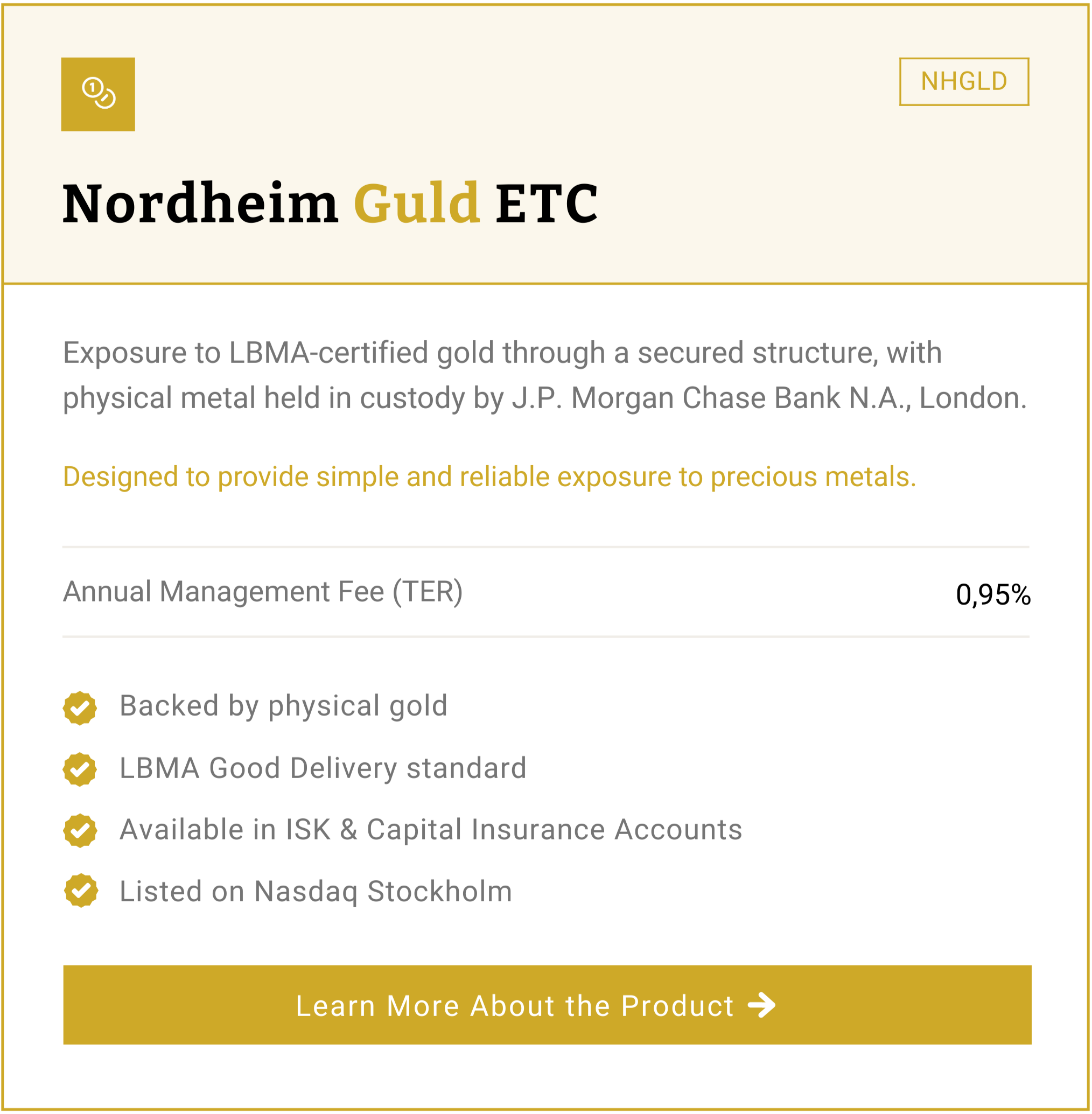
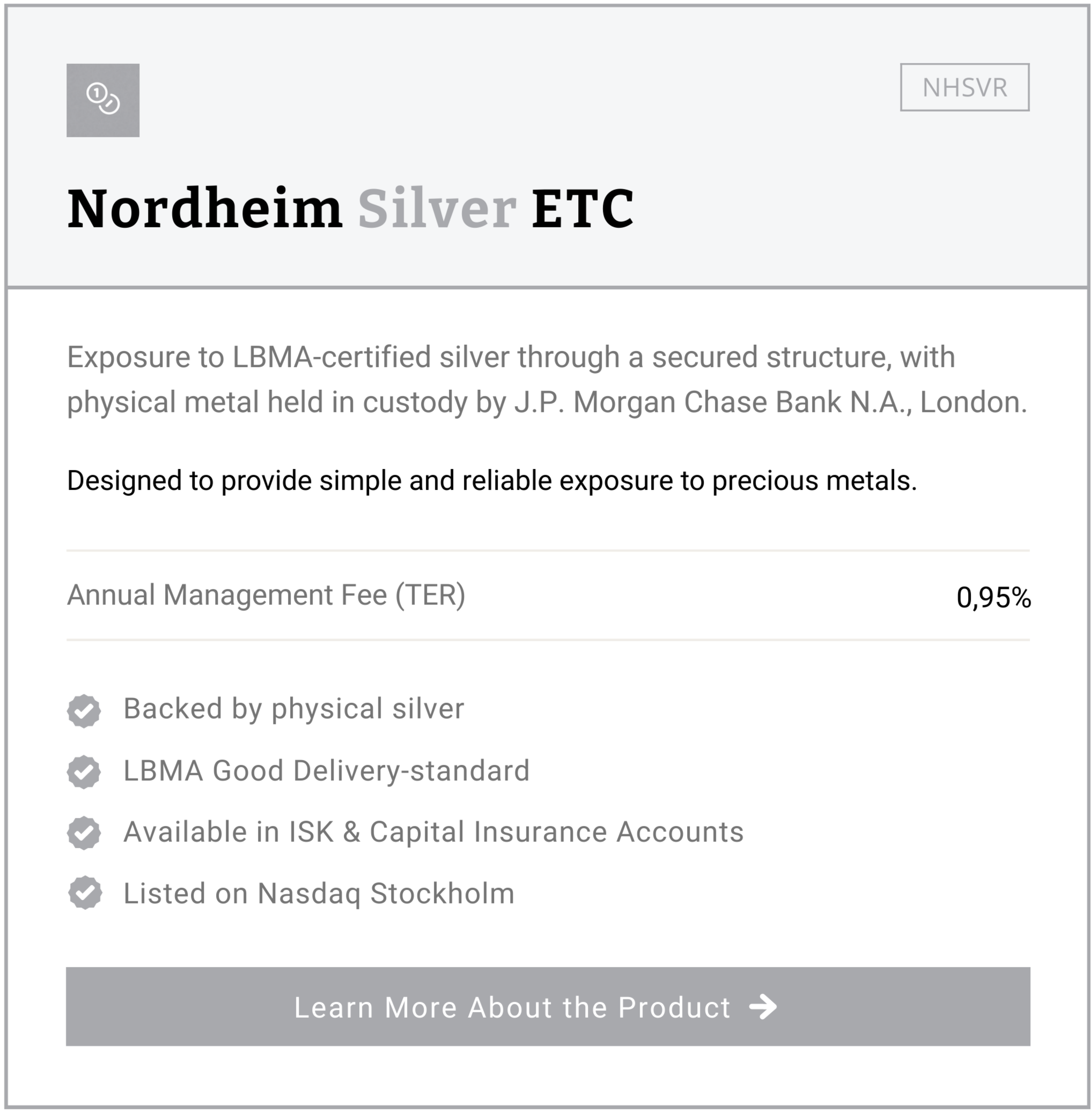
Nordheim Guld ETC tracks the price of physical gold, while Nordheim Silver ETC tracks the price of physical silver. The ETCs are structurally identical but provide exposure to two distinct precious metals, each with its own characteristics, price dynamics, and sources of global demand.
-
A gold ETF is an exchange-traded fund that may be physically backed by gold or may provide exposure to the gold price in other ways, for example through derivatives or futures.
Nordheim Capital’s gold and silver ETCs, by contrast, are exchange-traded commodities issued as securities and traded on Nasdaq Stockholm. They are designed to be simple, transparent and always physically backed by gold and silver, respectively, held with Nordheim Capital’s custodian, J.P. Morgan Chase Bank N.A., London.
Nordheim Capital’s ETCs track the price development of the underlying precious metal.
-
The NAV is based on the official LBMA price of the underlying precious metal together with the prevailing USD/SEK exchange rate, and serves as the reference valuation point for the creation and redemption mechanism.
NAV is calculated by starting with the market value of the physical precious metal held in custody by the independent custodian, J.P. Morgan Chase Bank N.A., London. The management fee is then deducted, and the remaining net value is divided by the number of outstanding ETCs to determine the NAV per ETC, which is published after each trading day.
-
London Bullion Market Association (LBMA) is the leading international trade association for the precious metals market. It sets globally recognised standards for the certification, trading, refining, and custody of gold and silver, helping to ensure transparency and trust across the market.
The Good Delivery standard is a globally recognised quality certification that imposes strict requirements regarding purity, weight, and bar markings. Gold and silver that meet the Good Delivery standard are approved for use by central banks and institutional market participants around the world.

About the Products
6 questions in this category
Trading & Security
5 questions in this category
-
Nordheim Capital’s ETCs are traded on Nasdaq Stockholm, a regulated market. You can trade our products in the same way as shares through your online broker or bank.
Search for the product name or ISIN on your trading platform and place an order during Nasdaq Stockholm’s opening hours.Read more about the products here.
-
Yes. Nordheim Capital’s ETCs are listed on Nasdaq Stockholm and are exchange-traded securities, which means they can be held in an Investment Savings Account (ISK), a Capital Insurance account (KF), or a traditional securities account. The products are available through leading Swedish brokers, such as Avanza, Nordnet and Montrose.
-
You can buy or sell individual securities in the same way as shares. The minimum requirement is one unit per product.
-
Nordheim Capital’s ETCs use a creation and redemption mechanism to keep the market price as close as possible to the Net Asset Value (NAV).
Authorised Participants - in Nordheim Capital’s case, Virtu Financial Ireland Limited - create new ETCs by delivering the consideration, in accordance with the Terms and Conditions of Nordheim Capital’s ETCs, to the custody account provided by the Custodian, J.P. Morgan Chase Bank N.A., London.Upon redemption, Virtu Financial Ireland Limited transfers the ETCs for cancellation and receives the consideration back to the extent and on the terms set out in the Final Terms. This mechanism creates arbitrage incentives that help keep the ETCs market price close to the actual value of the underlying precious metal.
-
Nordheim Capital’s ETCs can be traded during Nasdaq Stockholm’s regular trading hours, Monday to Friday from 09:00 to 17:25 CET, excluding Swedish bank holidays. Pricing takes place continuously throughout the trading day, just like traditional trading with stocks.
Custody & Security
4 questions in this category
-
All underlying precious metal is held with J.P. Morgan Chase Bank, N.A., London - one of the world’s leading and most respected Tier-1 custodians.
J.P. Morgan Chase Bank, N.A., London is LBMA-certified and meets strict international requirements for the secure handling and custody of these precious metals.
Find more information in Structure & Security. -
Yes. The precious metals are held in a separate, dedicated account with Nordheim Capital’s custodian, J.P. Morgan Chase Bank, N.A., London, and are clearly segregated from both Nordheim Capital’s own assets and J.P. Morgan Chase Bank, N.A., London’s proprietary holdings. This means that the precious metals form part of the ETC programme’s asset pool and do not belong to Nordheim Capital.
-
No, not at this time. Physical delivery of the precious metals only takes place through the creation and redemption mechanism and is, in practice, reserved for Authorised Participants - in Nordheim Capital’s case, Virtu Financial Ireland Limited - who handle institutional volumes.
-
If Nordheim Capital were to become insolvent, each ETC would still be backed by a corresponding physical precious metal asset. These assets are intended to be realised for the benefit of investors and serve as collateral for the ETCs.
Risks & Legal Information
6 questions in this category
-
No. Nordheim Capital’s ETCs are not capital protected. The value of the products can both increase and decrease depending on the price performance of the underlying precious metal and fluctuations in exchange rates. Investors may lose all of their invested capital, which would require the price of gold and/or silver to decrease to zero.
-
No capital protection: The value of the ETCs are affected by the performance of the underlying precious metal, exchange rate movements, fees, and market pricing. Investors may lose all or part of their invested capital.
See further information in the question above. (Are Nordheim Capital’s Products Capital Protected?)
Currency risk: The underlying precious metals are priced in USD, which means that changes in the USD/SEK exchange rate may affect the value of the ETCs in Swedish kronor.
Liquidity and market risk: Trading may take place with wide spreads or at prices that deviate from the ETCs’ underlying value, particularly during stressed market conditions or periods of limited liquidity.
Custody and counterparty risk: The underlying precious metal assets are held with Nordheim Capital’s external custodian, i.e. J.P. Morgan Chase Bank N.A., London. Operational disruptions, insolvency, or other issues affecting relevant parties may impact investors’ ability to receive payment.
Operational and regulatory risk: The products depend on functioning systems, external service providers, and a regulatory framework that may change over time.
Read the full risk information in the Prospectus.
-
The applicable tax treatment depends on the account type used. Holdings in an Investment Savings Account (ISK) are generally taxed using a standardised tax calculation. Holdings in a Capital Insurance account (KF) are generally taxed in a similar way. For holdings in a traditional securities account, realised gains are generally taxed as capital income at 30%, while realised losses are generally deductible.
-
The management fee (Total Expense Ratio, TER) is the annual charge that covers the administration, custody, listing fees, and ongoing operating costs of each product. It is calculated on a daily basis and gradually reduces the amount of precious metal backing each security, meaning that the product’s NAV is adjusted continuously to reflect the fee with the product still fully backed at all times.
The applicable fee is set out in the product’s Final Terms and Key Information Document (KID).
The KID for Nordheim Gold ETC can be found here.
The KID for Nordheim Silver ETC can be found here.
-
Nordheim Capital AB (publ) is a Swedish public limited company and issuer of ETCs, with its registered office in Stockholm. The company’s EU Base Prospectus has been approved by the Swedish Financial Supervisory Authority (Finansinspektionen) in its capacity as the competent authority under the EU Prospectus Regulation.
In addition, Nordheim Capital is subject to applicable rules relating to market disclosure, market abuse, and investor information, including relevant requirements under the PRIIPs Regulation and the Key Information Document (KID) framework.
-
The EU Base Prospectus, Final Terms, and Key Information Documents (KIDs) for all Nordheim products are available in the Investor Relations section on our website. We recommend that you read these documents carefully before making any investment decision.

Our Products
Two Products - Always Physically Backed
How to invest
Our products can be held through ISK, Capital Insurance Accounts, and traditional brokerage accounts with a range of brokers. Additional platforms will be added over time.
Can't find your broker above? Contact us